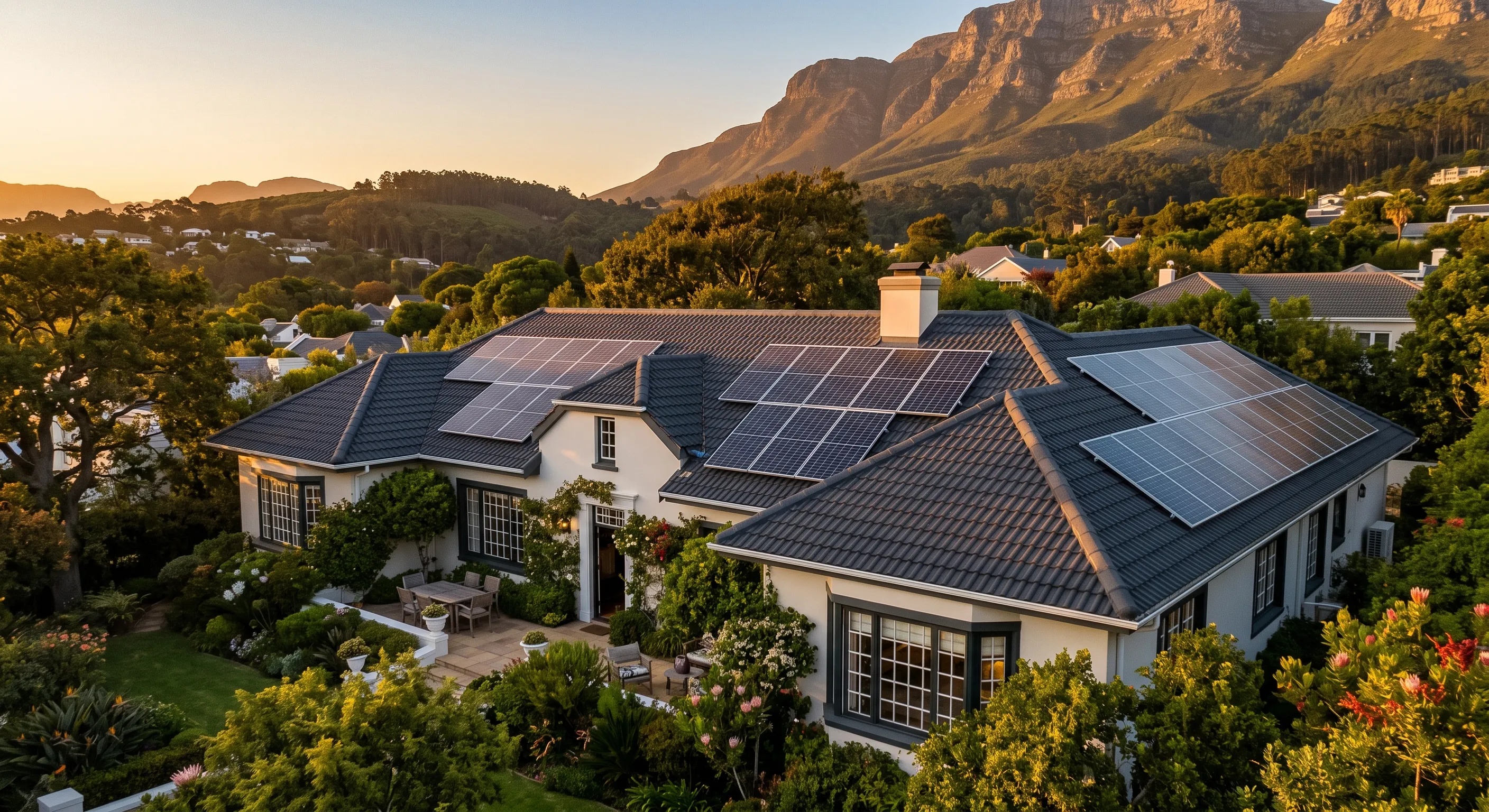
Up to R1 000 a month
for the solar your home doesn't use
The City of Cape Town credits R1.33 a kWh for exported solar against your municipal account, but only for registered systems with a bidirectional meter. WattButler handles the registration, start to finish.
Check my eligibilityFree · No payment now · Reply within one business day
You will not be sourcing an engineer.
The City requires professional engineer sign-off — homeowners can't shortcut that. And the meter installation stalls unless someone stays on it. We hold the first. We chase the second.
Two questions: your system size, and who bills you for electricity. No documents to dig out, no breaker sizes to check. We confirm whether your property qualifies and what it will involve, and reply within one business day.
We come to you. We photograph the installation to the standard the engineer needs — inverter markings, DB board, isolators, earthing, array — and put the ECSA-registered professional in place. Finding that engineer independently is where most homeowner attempts stall. You are not sourcing one, briefing one, or explaining your inverter to anyone.
Once permission to install is granted, the City begins writing to you directly as the account holder. Forward those to us and the City redirects to us from there. We handle the queries, the commissioning documents, the AMI meter process and activation.
None of this is difficult on its own. It is long, particular, and easy to stall on once. That is the part we take. See all twelve City steps, and who does each one.
No payment now · Reply within one business day
Estimate the credits your roof could be missing
Use your system size and installation month for a directional estimate. Your actual export depends on generation, orientation, battery behaviour and how much solar you use at home.
Have that ~R7,020 checked properly.Check my eligibility
Estimate uses 55 kWh of monthly export per installed kW and the 2026/27 non-VAT residential rate of R1.3298/kWh. It is not a quote or guarantee.
Check my eligibilityEvery unregistered month is solar value
you cannot recover later.
The highest-yield months run November to February. A 10kW system earns roughly R1,000 a month across them, against about R730 averaged over the year.
Approval and connection take 6–12 weeks from a complete application. An application started in August is exporting for all four of those months. One started in November is exporting for the last of them, if that. The difference is not three months of credits — it is most of a peak season, and the next one is a year away.
The feed-in tariff and the SSEG incentive remain subject to annual Council review.
"December was the month it clicked. Roughly a thousand rand credited, in the middle of summer, from surplus we weren't using anyway. It won't be that every month — but it made the whole thing feel finished."
Summer months generate roughly 35–40% above the annual average. Across a full year, a system this size averages closer to R730 a month. This is our co-founder's own registration, completed before we began taking clients. We opened to clients in June 2026 and have four Cape Town registrations under way.
R4,000 — the engineer, the application, and the follow-through
Included in the fee
- Eligibility and inverter validation — we confirm your inverter is on the City's approved list before anything is submitted
- Supply and MEC verification — breaker rating, phase configuration and overhead-supply check
- On-site documentation visit — we come to the property and photograph the installation to the engineer's standard
- Application preparation and submission — the full City SSEG export submission, assembled and lodged
- ECSA professional sign-off — coordinated with our contracted registered engineer
- City correspondence and queries — we hold the file and answer, so you don't
- Metering and activation tracking — through to meter installation and your first credited month
- Tariff migration guidance — the Home User move, and your Time-of-Use position
Costs that sit outside our fee
Three costs are set by the City and your existing installation, not by us. We establish all three before you commit to anything.
- City AMI bidirectional meter — quoted and charged directly by the City. Required for any exporting home.
- Street-boundary meter box or cabling — where the existing metering position doesn't meet the City's requirements. This is the variable that most often changes the arithmetic.
- Remedial electrical work — where the installation needs correction before the City will approve it.
We price these into your assessment before you pay the balance. If the total puts your payback period somewhere you'd rather not go, we will tell you so and you will not proceed. We would rather lose the application than register a home that shouldn't have been registered.
How you pay
Each R2,000 is invoiced when it falls due, and settled by Visa or Mastercard card, or by Instant EFT straight from your bank. The eligibility check is free — nothing is payable until you book.


What it costs, and what it returns
| Export credit, 2026/27 residential | R1.33 / kWh |
| Est. monthly credit, 10kW system | ~R731 |
| City AMI bidirectional meter (once-off, incl. VAT) | R6,651.90 |
| AMI administration fee (monthly) | ~R7 |
| WattButler — site inspection and application | R2,000 |
| WattButler — balance on your metering quotation | R2,000 |
Once-off cost: R10,651.90. A 10kW system recovers it in about fifteen months.
The meter is a City requirement for any registered export system, not a WattButler charge — you pay it whichever way the application is submitted. It is also the only route onto the City's residential Time-of-Use tariff, which lets a household with a battery buy at off-peak rates instead of peak ones. We tell you whether that is worth doing for your property.
Some properties need a compliant street-boundary meter box or cabling before the City will connect. Where that applies, we establish it and price it before you pay the balance.
The full cost detail, including how the credit is calculated →
The R2,000 balance falls due only when the City issues your metering quotation. If a rejection is within our control — documentation, submission, or a compliance issue our screening should have caught — it is never invoiced, and refunded if you have already paid it. The first R2,000 has paid the site visit and the ECSA professional, who is paid for the assessment and not for the outcome. Property-specific requirements and the City's own approval decisions sit outside that.
What clients typically ask
If your property is valued at R1 million or more you are already billed on Home User, and its R424.30 monthly fixed charge is already on your statement. Below that threshold you would be moving onto it, which is a real change to your bill — the fixed charge is higher and the per-unit rate lower, so whether you come out ahead depends on how much you use. We model both before you commit.
It suits households with battery storage that can shift consumption out of peak periods. It suits a home without a battery far less, and the tariff carries no free basic electricity allocation. The City moves nobody across automatically — it takes a written request.
We model both tariffs against your property during the assessment and tell you which is better for you. If Time-of-Use is the answer, we submit the request. Time-of-Use feed-in rates are not yet in service; the City has said they will follow once its systems have been tested, so export credits are at the standard rate either way.
If the rejection was caused by something within our control — documentation, submission, or a compliance issue our screening should have caught — you are not invoiced for the R2,000 balance, and we refund it if you have already paid.
If it was caused by the property itself, we tell you plainly what the City requires and what it is likely to cost. The first R2,000 covers the site inspection and the ECSA-registered professional, who is paid for the assessment whether or not the application succeeds.